Skip to content

TREATMENT SUCCESS RATES

 Care Fertility delivers IVF success rates consistently higher than the national average — leading the way in helping more families begin. 

Success rates

Each of our 16 UK clinics reports its outcomes individually to the HFEA, and those clinic-level results are independently verified and publicly available. Every Care Fertility clinic is regulated, inspected, and validated in exactly the same way as any other licensed UK clinic.

Because we’re a national network, many patients want to understand our outcomes as a whole — not just clinic by clinic. To provide that clarity, we combine our verified clinic data to create a group metric. Our national success rates are built using the same HFEA-verified data submitted by each individual clinic. We aggregate those verified results to give a meaningful picture of outcomes across Care Fertility as a group.

We know that going through fertility treatment can be challenging. You need clear, honest information about things like success rates and costs. You also need to feel confident that your clinic team will support you at every stage, and that your treatment plan will be tailored around your individual needs.

Choosing a fertility clinic is a big decision, and the right support can make a real difference. Across all 16 Care Fertility clinics, our teams are committed to delivering personalised treatment, transparent information, and expert care — all focused on helping you move closer to starting your family.



Measures of IVF success

When you’re looking at IVF success rates, it can feel like you’re comparing numbers that don’t quite match up. Different clinics may present different measures, and each one tells a slightly different part of the story.

At Care Fertility, we believe success rates should be clear, meaningful, and focused on what matters most to you. That’s why we use a range of recognised measures to give a balanced and transparent view of outcomes.

Below, we explain what each measure means — and why it’s used.

Unfertilised Egg Illustration
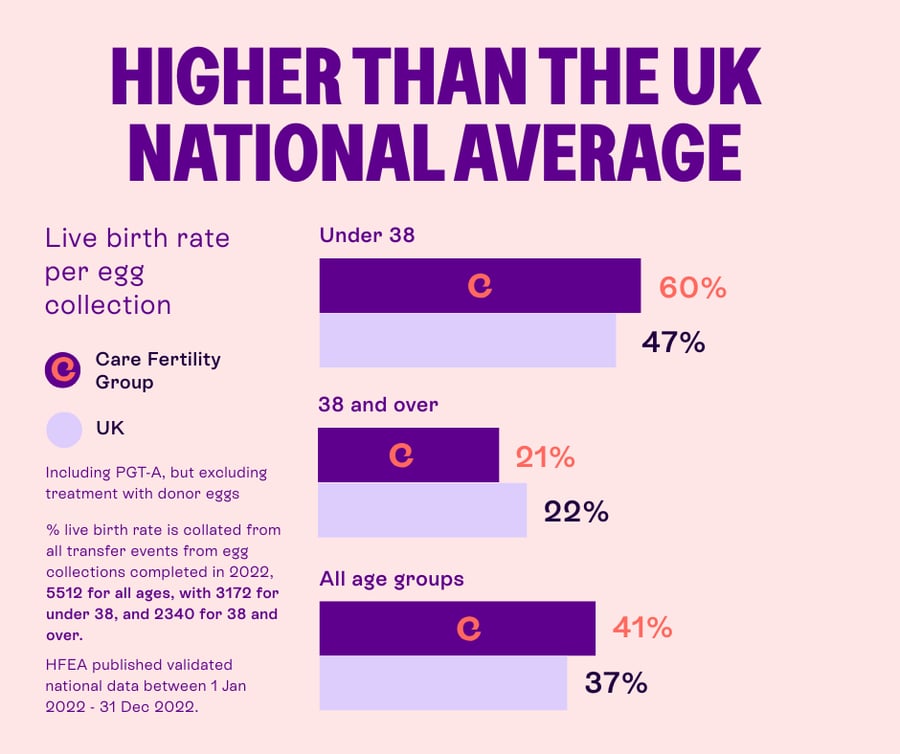
Live birth rate per egg collection

Live birth rate per egg collection tells you the chance of a live birth from a single egg collection cycle, including any fresh and frozen embryo transfers that come from that collection. We use it because it reflects the overall outcome of one full stimulated cycle, not just one step along the way.

This includes all treatment cycles using a patient’s own eggs, including those with PGT-A, but excludes treatment using donor eggs.

Click here to see our HFEA verified success rates

Illustration of DNA cells from an embryo being tested during PGT-A  | Care Fertility
PGT-A vs. no PGT-A

PGT-A and non-PGT-A cycles involve different approaches to embryo selection. In a PGT-A cycle, embryos are tested for chromosomal differences before transfer. Only embryos identified as chromosomally suitable are transferred or frozen for future use. In a non-PGT-A cycle, embryos are selected based on how they develop and appear in the lab, without genetic testing.

We present outcomes separately so you can clearly see how treatment performs with and without genetic testing, and understand what each approach may mean for you.

Click here to see PGT-A vs. non PGT-A cycle success rates


Live birth per egg collection success rates

Live birth rate per egg collection looks at how many egg collection cycles result in the birth of a baby. In simple terms, for every 100 egg collections, how many lead to a live birth.

This metric starts counting from the point of egg retrieval — after ovarian stimulation and the egg collection procedure have taken place. It includes the outcomes of any embryos created from that collection, whether they are transferred in a fresh cycle or after being frozen and transferred later.

It’s a helpful and meaningful way to measure success because it reflects the outcome of a complete treatment cycle, not just one stage of it. Rather than focusing on fertilisation rates, embryo development, or a positive pregnancy test, it looks at the outcome that matters most: taking home a baby.

By measuring success per egg collection, we’re able to give a clearer picture of what one full stimulated cycle may lead to overall.


Care Fertility Group - LBR Per Egg Collection - 2022 - HFEA verified success rates


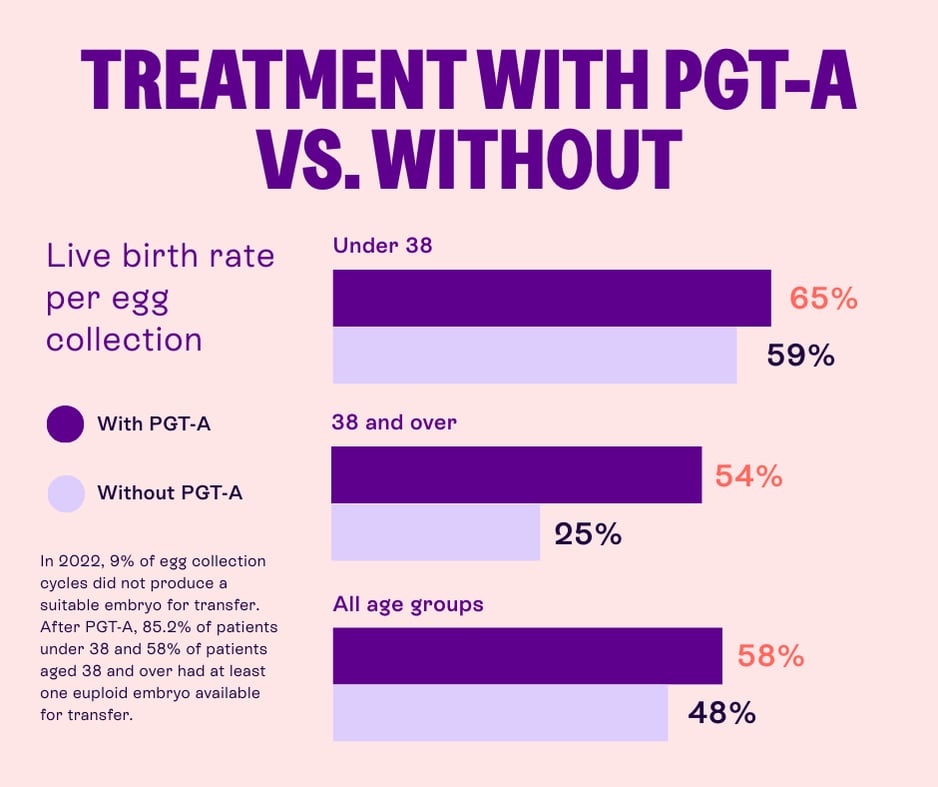
Treatment with PGT-A vs. without PGT-A

This data compares IVF cycles where pre-implantation genetic testing for aneuploidy (PGT-A) was used with cycles where it wasn’t.

PGT-A is a laboratory technique carried out during IVF to check embryos for the correct number of chromosomes before transfer. Rather than choosing an embryo based only on how it looks under the microscope, we can also assess whether its chromosomes are balanced. This can help reduce the risk of miscarriage and failed implantation, particularly as maternal age increases.

As women get older, eggs are more likely to develop chromosomal differences. When an embryo has an abnormal number of chromosomes (known as aneuploidy), it may not implant or may stop developing early in pregnancy.

PGT-A helps identify embryos that are chromosomally balanced (euploid) before transfer. For some patients — particularly those aged 38 and over, or those who’ve experienced recurrent miscarriage or repeated implantation failure — this additional information can help guide embryo selection.

A graph showing the success rates of cycles using PGT-A vs. those without PGT-A at Care Fertility.

When an embryo isn’t available for transfer

Sadly, not every IVF cycle results in an embryo that can be transferred. In 2022, some patients who had an egg collection did not have a suitable embryo available for transfer. A suitable embryo is one considered by the embryologist to be good enough to transfer or freeze. If genetic testing is used, the embryo must also be chromosomally balanced (euploid).

Around 9% of patients had an unsuccessful egg collection cycle, meaning no eggs were collected, eggs did not fertilise, or embryos did not develop to a stage suitable for transfer, freezing, or testing.

When PGT-A is used, embryos are also tested for chromosome balance. Some embryos may be identified as aneuploid and therefore cannot be transferred, meaning some cycles may not result in a transferable embryo after testing.

In 2022, among patients who had a successful egg collection and PGT-A:

  • 85.2% of patients under 38 had at least one euploid embryo available for transfer
  • 58% of patients aged 38 and over had at least one euploid embryo available for transfer


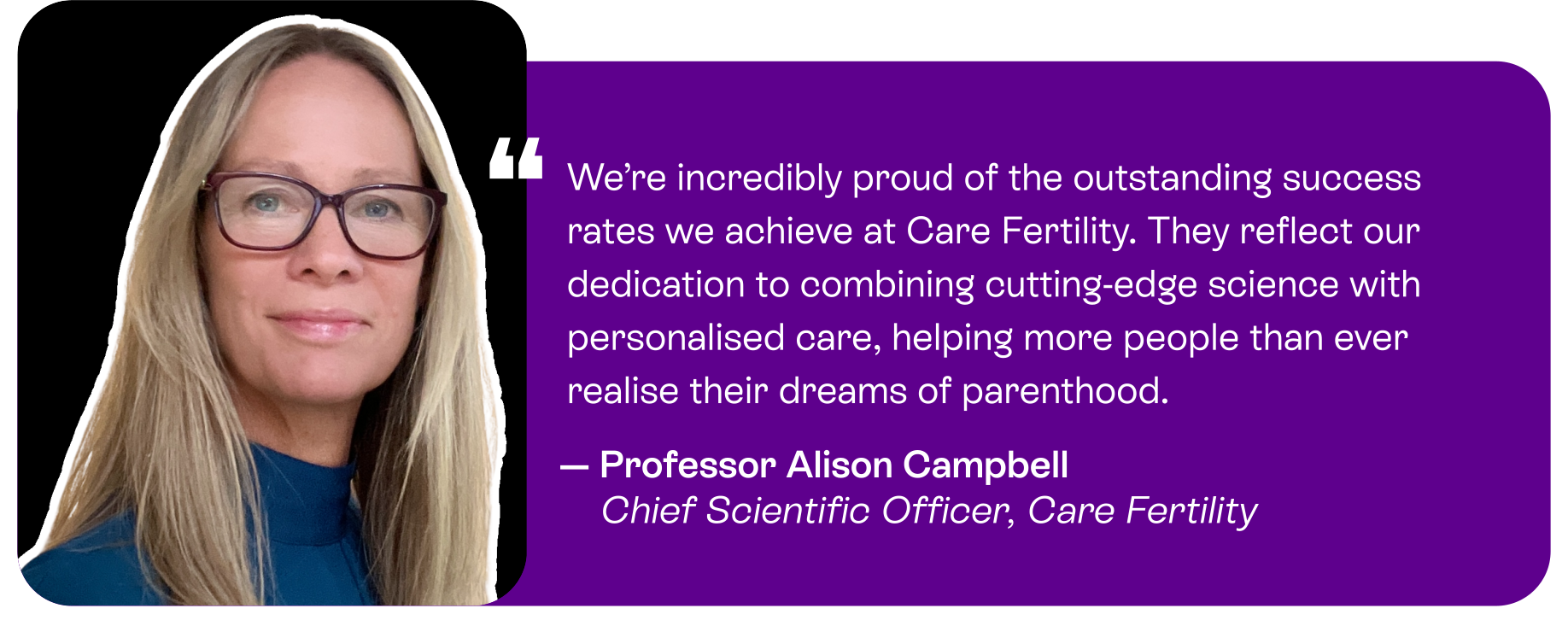
We’re incredibly proud of the outstanding success rates we achieve at Care Fertility - Professor Alison Campbell, Chief Scientific Officer


Success rate validation

Our success rates are based on our most recent validated data and reflect the outcomes achieved across Care Fertility clinics. These figures have been independently verified by the Human Fertilisation and Embryology Authority (HFEA) and published in 2026.

For the HFEA-validated period of 2022, our live birth rate per egg collection data includes all cycles using a patient’s own eggs. Where we present PGT-A and non-PGT-A outcomes separately, these figures are taken from the same validated dataset and then carefully analysed by our scientific team to distinguish between cycles with and without PGT-A. 

It’s important to remember that success rates are only one part of the picture when choosing a fertility clinic. For guidance on making an informed decision, we recommend visiting the HFEA’s advice page.

You can explore how our results compare with national averages by using the HFEA’s ‘Choose a Fertility Clinic’ tool.

Please note: we do not publish success rates for clinics with very small numbers of cycles, as this can produce misleading figures.

5